Profitability Troubleshooting
Struggling to scale your ad spend while staying profitable? We’ve got you covered.
This framework will give you the exact strategies DTC Alternative Health & Wellness brands use to maximize ROAS. When you need to fine-tune ad performance, these proven methods will help you identify what’s working and what needs help.
Bonus: Want to double your ROAS in 90 days or less? Click here.
1. Purpose
This guide helps you figure out if your ad campaigns are making money like they should. It uses simple tools and key numbers to measure success. The secret to scaling ads is knowing how much you can afford to spend to get customers.
2. Background
For eCommerce brands, two key numbers matter: profit margin and customer value over 60-120 days. These show if you’re earning enough to cover costs. You can track these using affordable tools like:
Attribution Tool (e.g., Triple Whale) – Tells you which sales come from ads vs. other sources.
Cohort Analysis Tool (e.g., Lifetimely) – Shows how much customers spend over time.
Attribution tools are important because they allows us to separate out new customers who we can reasonably expect came from our ads vs. those who would have come in from other non-paid channels like organic, word-of-mouth or even people who ran out of our product after buying through physical retailers or Amazon.
What’s more, a 1st party attribution tool allows us to avoid many of the security measure employed by companies like Apple to prevent users from being tracked by other 3rd party attribution tools like Meta’s ads pixel.
For this guide we will use Triple Whale for our 1st party attribution tool and Lifetimely for cohort analysis as these are the most cost effective solutions for brands working on Shopify.
For context, here are some of the displays we will be looking at.


3. Key Profitability Metrics
3.1 ROAS & CPA (Return on Ad Spend & Cost Per Acquisition)
Why This Graph?
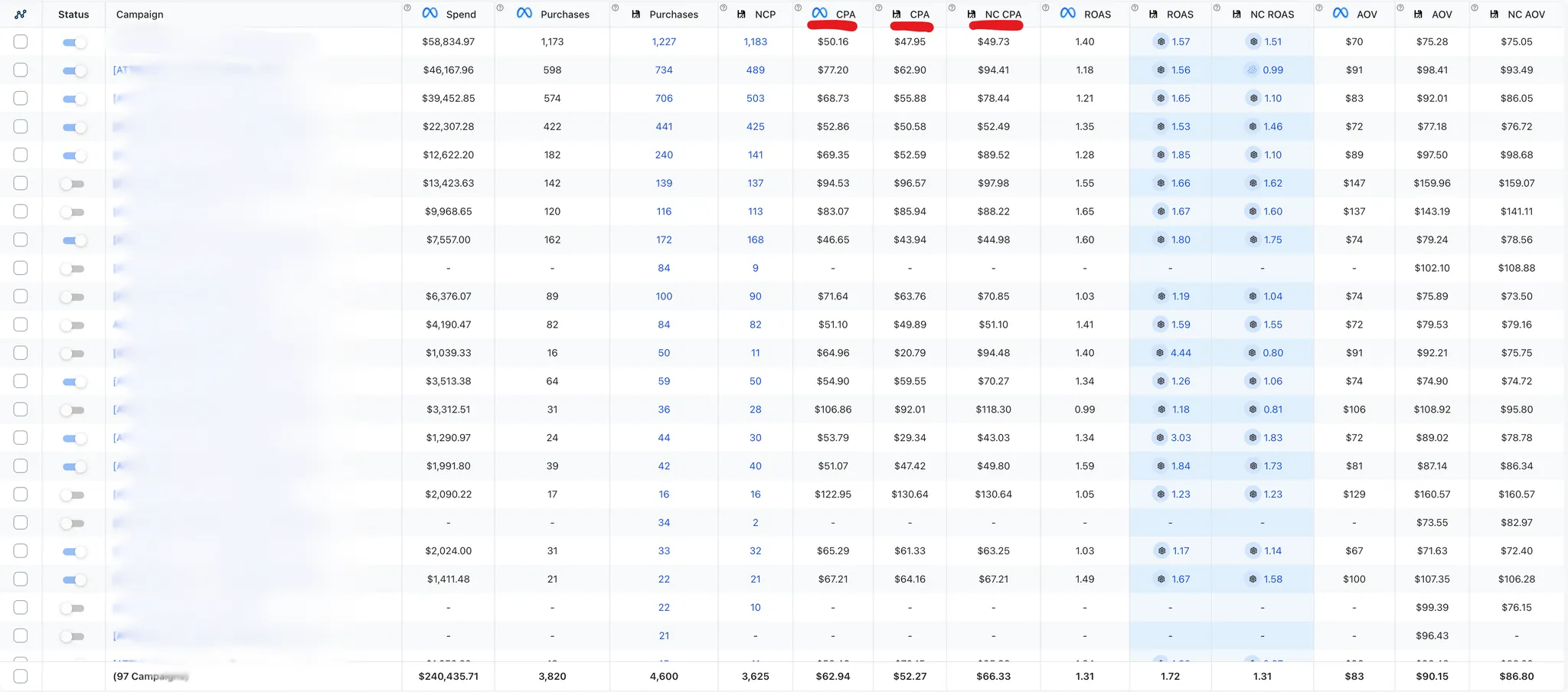
The important point is the difference in CPAs depending on attribution.
Meta's CPA is based on a 7-Day Click attribution model
Triple Whale’s CPA is based on it’s last click attribution model
Triple Whale’s NC CPA is based on it’s last click model with an additional filter for Shopify new customers
Which one is most accurate?
This depends on why you are using the graph. In this case we are going to apply this graph to the cohort analysis we will be doing in the following sections. The important point is that you understand exactly what the CPA readout you are looking at is measuring.
In this case, we will use Triple Whale’s NC CPA which tells us which customers meet these conditions:
new customers in shopify
last click on facebook that came from the campaign the purchase was attributed to
NOTE: We will use this as it’s a fairly strict measure of performance given the fact that we are considering Meta ads running by themselves for this example. De-duplicating multiple channels requires an additional step that’s outside the scope of this basic profitability assessment.
NOTE to the NOTE: Even without de-duplication across channels, this is stricter then what 90% of brands are looking at, so if you only get this far, you’re in a good place.
3.2 Applying Costs to P&L (Profit & Loss)
The important point is the differences in AOV and LTV of customers in different monthly cohorts.
The numbers at the top represent the # of months from the customers time of first purchase
The numbers on the left side in the “first-order” column represent the month the customers in each cohort made their first purchase
The dollar amounts in the middle of each square on the graph represent the average gross margin per customer who purchased in that month’s cohort
We can see the average gross margin per customer in each monthly cohort increasing as time goes on.
NOTE: We don’t want to use Lifetimely’s estimate for customer acquisition costs for scaling advertising. The reason for this is that Lifetimely is looking at the overall marketing spend without taking into account the attribution model that we are using to assign credit to the various ads platforms.
Finding our Payback Period
In order to find our payback period we will take our customer acquisition cost from step 3.1 above. As I mentioned, we will do this by looking at your new customer CPA in Triple Whale. For the example shown in the Lifetimely report above we will assume the customer has an NC CPA of $150.
Given our true customer acquisition cost of $150, we see that the average customer above reaches the break even point within 30-60 days after purchasing. The only exception are the August, September and October cohorts which look like they may take up to 90 days to reach a break even point.

3.3 Cohort Profitability by Product
Why it matters: Some products bring in better customers.
Best method: Break down customer groups by first purchase.
Example: Some products attract repeat buyers, while others don’t.

Why This Graph?
This shows the difference in cohort value based on the product of first purchase.
Important points you’ll notice above:
massive difference in AOV between products
massive difference in eventual lifetime value of customers
shows the total number of new customers by product for the total time period
<aside>
NOTE: The most important thing about this graph is it’s ability to show you the change in relative amounts of new customers coming in from different products. Changes in the mix of customers by 1st product purchase will have a massive influence on profitability.
</aside>
Finding out Trends in Payback Periods
Once you have a rough estimate of the LTV of customers over different periods of time, based on their product of first purchase, you can look at your NC CPAs by campaigns for the various products you are advertising to determine whether or not you are reaching a break even point within an acceptable timeframe to meet your financing requirements.
Inevitably you will see that certain campaigns will promote products that have a customer acquisition cost and customer cohorts with an acceptable payback period.
4. Troubleshooting Profitability (6-Step Process)
Pick an attribution model (e.g., last click in Triple Whale).
Calculate real new customer CPA (filter out returning buyers).
Check if customer value is increasing over time.
Compare CPA vs. customer value to find break-even point.
Analyze which products bring in high-value customers.
Make sure product payback periods fit your budget.
BONUS: Customer Value Growth Trends
Track long-term trends: If customer value is dropping, investigate ad spending, product pricing, and discount codes.
Watch for “discount” customers: These buyers may not be worth the lower prices if they don’t return.

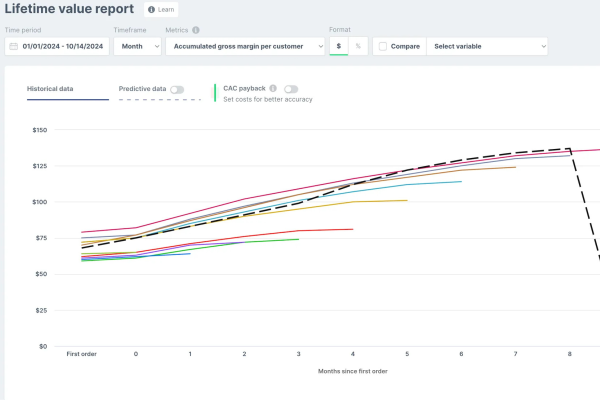
Why This Graph?
This shows the side by side change in progress in accumulated gross margin per customer grouped by month of first purchase. It’s a way to visualize cohort analysis so you can see broad trends.
What we see in the graph above is a reduced increase in average gross margin per customer throughout the year with drastic drops in average increase from April to may and may to June.
In this case, the decreases were caused by the compounding of 2 factors:
Increased spending on campaigns for products that had a smaller AOV and increase in LTV
The fact that the reduced AOV and LTV was masked by much lower acquisition costs which made the day 0 ROAS appear superior to other more profitable products
The use of coupon codes that further reduced gross margin per customer
Want to double your ROAS?
Scaling profitably requires more than just running ads—it’s about optimizing every touchpoint in the customer journey. This framework will make your ads work harder for you.

